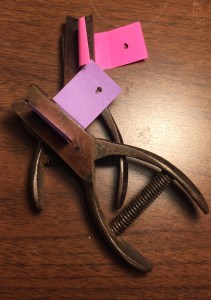
If you were lucky the conductor would, after awhile, end up sitting in the end of your car. Where, with hat off, vest unbuttoned, he would be doing “his train business.” Sorting the tickets, writing out the “car orders.” And later once his work was finished you might talk with him about “train stuff.”One thing for sure, it was his train, he was in charge and nothing escaped him. It was amazing how he knew where he was on the route just by the sound to the train. When it came time for the next stop he would stand up, button his vest, put on his cap and announce,”Blue Island, next stop Blue Island, this way out!” On his way out of the car he would pull his “railroad watch” from his vest pocket and check on the timeliness of the transit of his train.
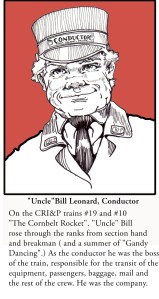
When I was a boy , I knew a conductor, “Uncle Bill” Leonard, his division was from Chicago to Rock Island. He was a big man, or was to me. His deep blue suit, massive hands and omni present cigar made a lasting impression. When we visited with him at his big White House on 15th Street and 19th Avenue, we would sit on his wrap-around porch. In the white wicker furniture he would rock back and forth and tell stories of the rail road, the people he’d met, the adventures he had and laugh heartily. When the stories got too outrageous, his wife, “Aunt Annie,” would say, “Bill, quiet it down, don’t want to give the boy ( me) a bad impression, now , do you ?”And he would restrain himself for awhile, then he’d take another swig of lemonade and begin another story, only half as wild as the one before.
 First of all , I am not concerned with getting anywhere. The whole idea is the trip. This was the consideration from the beginning. It also was one last time to really get a dose of riding the train, as the train for me is magical and has always been. The idea of traveling this way has been ingrained in me from the beginning. Before I was aware of the idea of the train. I suspect that when I was taken to Michigan for the first time , it might have been on the train. ( There is no record of how my parents got me to Pontiac back then.) But if it was not by car then it was by train. So from the very beginning I was involved with riding the trains and as I grew older my facination with trains, especially passenger trains would remain with me.
 billybobrailcom